Showing posts with label dental implant. Show all posts

Tuesday, January 17, 2017

You Should Brush and Floss Around Your Implant to Ensure its Longevity

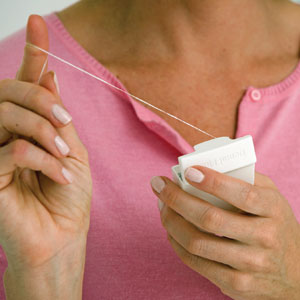
floss.With a 95%-plus success rate, dental implants are an effective and durable replacement for lost teeth. But we can't place them and forget them: if you don't clean and maintain them they could fail as a result of disease.

The inorganic materials that make up the implant aren't in danger of infection. But the living gums and bone that surround and support the implant are at risk. In fact, there's a particular periodontal (gum) disease involving implants called peri-implantitis (“peri” – around; implant “itis” – inflammation).

Peri-implantitis begins when the gum tissues around the implant become infected and inflamed. This happens most commonly because plaque, a thin film of bacteria and food particles, builds up on implant surfaces. Another less frequent cause is a buildup of excess cement used to bond the crown to the implant. We need to remove the built-up plaque or the excess cement during your dental visit.

If the infection isn't treated or you don't keep up effective, daily hygiene practices, the infection can grow and extend deeper into the tissues and finally the bone. This can destroy the all-important integration of bone and metal titanium post that has created the implant's strong hold. When that support becomes compromised the implant can lose its attachment and, if untreated, eventually fail.

It's important to keep an eye out for any indications you may have a gum infection around an implant. Look for redness, swelling, bleeding or pus formation. If the implant feels loose, this may mean that extensive bone loss has already occurred. If you encounter any of these signs, see us immediately for an examination.

The best approach, though, is to prevent peri-implantitis in the first place. So, brush and floss daily around your implant as you do your natural teeth. And be sure you keep up regular dental cleanings and checkups.

With proper care and maintenance you can avoid problems with disease that could affect your implant. Healthy gums and bone will ensure your implant will last for many decades to come.

If you would like more information on preventing disease involving your dental implants, please contact Dr. Cindy Sumarauw at 801-281-3500 to schedule an appointment for a consultation.

Wednesday, September 28, 2016

Dental Implants Could be Your Best Option to Replace Lost Teeth

implants.An estimated 35 million people in the United States are missing all of their teeth on at least one jaw. Your situation may not be as serious — perhaps you've only lost one tooth. But even one missing tooth could eventually impact the health of underlying bone or other teeth — and it can certainly mar an otherwise attractive smile.

Depending on other health factors, you could be an ideal candidate for a dental implant to replace that missing tooth. Since their introduction in the 1980s, implants have rapidly become the popular choice for tooth replacement. They've gained this popularity for several reasons: they're a life-like replacement that also functions like a tooth; they're adaptable to a variety of situations; and they enjoy a 95%-plus success rate.

The key to their success lies in their unique construction: they replace the tooth root, not just the crown. They accomplish this through a metal titanium post imbedded directly into the bone. The titanium attracts bone cells, which eventually grow and adhere to the post to anchor the implant securely in the jaw. This growth also deters bone loss that occurs after tooth loss and continues after acquiring other forms of removable restorations like full or partial dentures.

If implants have one drawback, though, it's their cost, especially if you have multiple lost teeth. The good news if you're missing several teeth is that each tooth does not need an implant due to their inherent strength. As few as two implants could replace three to four missing teeth or play a role as supports for other restorations like removable dentures. Some of the implants' other benefits will also carry over, including enhanced bone health.

To determine if dental implants are a good choice for your missing teeth, you'll need to undergo an evaluation of your individual dental condition (including bone health). From there we can advise you on whether implants could change your dental health and your smile.

If you would like more information on dental implants, please contact Dr. Cindy Sumarauw at 801-281-3500 to schedule an appointment for a consultation. You can also learn more about this topic by reading the Dear Doctor magazine article “Dental Implants 101.”

Monday, January 18, 2016

Smoking Increases Your Risk for Dental Implant Failure

smoking.There are definite links between smoking tobacco and several major health problems. While we’re all familiar with its relationship to cancer or heart disease, smoking can also adversely affect your dental health, particularly the long-term survival of dental implants.

Smoking can affect your mouth in two ways: first, the inhaled smoke can slowly “cook” gum tissue to form a thickened top layer of cells and damage salivary glands, which reduces saliva flow causing mouth dryness. Second, the nicotine in tobacco may cause the mouth’s blood vessels to constrict and inhibit blood flow, which can weaken the body’s defenses and healing ability.

Put all these outcomes together and you increase your risk of periodontal (gum) disease that can cause the loss of supporting gum tissue and bone. Bone loss especially can have an adverse effect on implant stability, which relies on adequate bone for anchorage.

Slower mouth healing caused by smoking also lowers the chances of a successful outcome to implant surgery. Over time, bone in the jaw grows and attaches to the imbedded titanium implant, which will increase the implant’s strength and durability. With a weakened healing mechanism, however, this process known as osseo-integration may fail to develop fully. As a result, the implant won’t be as strong and stable as it could be and may fail when it encounters normal biting forces.

This scenario is borne out in a number of research studies. Although dental implants have a very high success rate, about 5% fail. Twice as many of those failures occurred in smokers compared to non-smokers. Although an implant isn’t destined to fail if you’re a smoker, your risks are much higher.

You can reduce that risk by trying to quit smoking a few weeks before implant surgery, or at the very least try not smoking a week before and two weeks after the procedure, and follow good oral hygiene practices to prevent gum disease. And, be sure to see us on a regular basis for checkups and implant maintenance.

Dental implants are a highly successful tooth replacement option that can give you decades of service. Don’t allow smoking to short-circuit that success.

If you would like more information on the impact of smoking and other lifestyle issues on dental implants, please contact Dr. Cindy Sumarauw at 801-281-3500 to schedule an appointment for a consultation. You can also learn more about this topic by reading the Dear Doctor magazine article “Dental Implants & Smoking.”

Tuesday, September 22, 2015

Look at the Long-Term Costs When Considering Dental Implants

implant.You’ve probably heard a lot of great things about dental implants as a replacement for missing teeth. But there’s one aspect about implants that may cause you hesitation about choosing them: the cost. If you have multiple teeth to be replaced, the expense of implants may seem even further beyond your means.

But before you decide against what’s widely considered the premier tooth replacement option, it would be beneficial for you to look at their cost from a long-term perspective. You may find implants are actually a cost-effective investment in both your oral health and your smile.

So, what sets the dental implant apart from other options? One of its most important attributes is its life-like appearance. Not only does the visible crown resemble the color, shape and texture of natural teeth, the implant’s placement can so precisely mimic the appearance of natural teeth emerging from the gums, it’s indistinguishable from the real thing.

They’re not just attractive, but also durable. This is due in large part to titanium, the most common metal used in implants, which has the unique quality of being osseophilic, or “bone-loving.” Bone cells naturally attract to titanium and over time will grow and adhere to the implant in a process known as osseointegration. As a result, the implant’s attachment in the jaw becomes strong and secure.

This durability gives implants a greater longevity on average than most other replacement options. If you thus compare the total costs for an implant (including maintenance) over its projected life with the costs of other options like dentures or fixed bridges, you’ll find implants may actually cost less over time.

That may sound affordable for one or two missing teeth — but what about several? Replacing multiple teeth individually with implants can be quite high; but implants are also versatile — just a few strategically placed implants can support a fixed bridge or overdenture. This “hybrid” solution combines the affordability of these other options with the stability of implants.

Before weighing your options, you should first undergo a complete dental examination to see if you’re a candidate for implants. From there we can help you decide whether implants are the right investment for your health and your smile.

If you would like more information on dental implants, please contact Dr. Cindy Sumarauw at 801-281-3500 to schedule an appointment for a consultation. You can also learn more about this topic by reading the Dear Doctor magazine article “Dental Implants 101.”

Wednesday, May 20, 2015

The Many Advantages of Dental Implants

dental implant.Dental implants have become the standard for long-term tooth replacement. From mechanics to movie stars, people from all walks of life have discovered the advantages of replacing a missing tooth with an implant. Obviously, restoring your smile is a definite advantage, but an implant can also help to maintain the health of your jawbone and adjacent teeth.

The implant is a small, screw-like titanium post that is placed into your jawbone to function as the root part of the tooth. The living bone tissue will actually attach to the titanium post, fusing them together. This will not only provide a sturdy anchor for a natural-looking crown, but will provide stability for bridgework or dentures. You will then be able to smile, chew and talk as if all of your teeth are natural. The procedure will also help to stabilize the bone, reducing long-term bone loss that occurs when a missing tooth is not replaced.

At this point, if you are thinking that there must be a lot of pain involved, I have good news for you. There is very little pain involved after the procedure is completed and no pain at all during the procedure. Typically, it is a routine surgery that takes place in a dentist’s office under local anesthesia where the immediate area is numbed. If there is any apprehension at all about the procedure, we will offer alternative anesthesia or sedation options during the planning process.

To determine who will be a good candidate for the implant procedure, a plan must be in place to assure the success of the implant. Part of the plan includes:

  • Reviewing your past medical and dental history. We must know your complete past and present medical history and medication use, since good health is essential. There are certain conditions and diseases that can affect the healing of an implant.
  • Performing a comprehensive dental examination. An evaluation of your dental problems and needs will determine if implants are in your best interests. An assessment of the health and mass of the jawbone as well as the number and location of the implant(s) that are needed to restore your bite and smile back to health will also be determined.

When the implant procedure has been successfully completed, there is one more step. As with your natural teeth, preventive maintenance is crucial for long-term success. A daily routine of brushing and flossing along with regular professional dental cleanings and checkups will help ensure continued gum health and proper functioning of your implants.

If you are wondering whether dental implants are right for you, contact Dr. Cindy Sumarauw at 801-281-3500 to schedule an appointment for a consultation. You can also learn more about dental implants by reading the Dear Doctor magazine articles “Dental Implants” and “Dental Implant Surgery.”

Friday, August 15, 2014

Major Benefits for Tooth Replacement With Dental Implants

implants.Perhaps you’ve heard a lot about dental implants, an increasingly popular tooth replacement system. Although they can be expensive (depending on the exact application) they have a number of important benefits that add value to your investment.

Here are four of those benefits that make dental implants one of the best tooth replacement options available:

Life-like Appearance. Like an automobile, an implant’s “engine” — the titanium post inserted into the jawbone — is covered by a stylish “body” — the visible crown, custom-made to look just like the natural tooth. Composed of porcelain ceramic or a similar translucent material, the implant crown is the key to not only restoring natural function in the mouth but also rejuvenating your smile.

Long-term Durability. Implants have been in use for over three decades (over 3 million placed since their introduction) and have built an impressive track record for durability. If properly cared for, it’s possible for dental implants to last for many years or even a lifetime. Compared with other restorations that may not last as long and lead to additional dental cost, the implant’s “return on investment” can be quite high.

Contribution to Bone Health. Most implants are made of surgical titanium, which has a strong affinity with bone. In time, bone cells will grow and fuse with the titanium. The result is not only a solid anchoring of the implant into the jaw, but also the preservation and possible re-growth of bone mass where it may have been lost.

Versatility. Although implants are often used as a single tooth replacement, they’re increasingly used in multiple-tooth replacements. A few strategically placed implants can permanently support a bridge (two or more teeth linked together), an arch (an entire set of upper or lower teeth), or as a foundational support for a removable denture, particularly the lower arch.

If you’ve experienced tooth loss, a preliminary dental examination will determine if you’re a potential candidate for dental implant replacement. If so, dental implants could be a way for you to not only restore lost function but also regain your smile.

If you would like more information on dental implants, please contact Dr. Cindy Sumarauw at 801-281-3500 to schedule an appointment for a consultation. You can also learn more about this topic by reading the Dear Doctor magazine article “Dental Implants 101.”

Monday, June 23, 2014

For Michael Buble, the Show Must Go On... Even Without the Tooth

buble.What happens if you’re right in the middle of a song, in front of an arena full of fans… and you knock out a tooth with your microphone? If you’re Michael Buble, you don’t stop the show — you just keep right on singing.

The Canadian song stylist was recently performing at the Allphones Arena in Sydney, Australia, when an ill-timed encounter with the mike resulted in the loss of one of his teeth. But he didn’t let on to his dental dilemma, and finished the concert without a pause. The next day, Buble revealed the injury to his fans on his Instagram page, with a picture of himself in the dentist’s chair, and a note: “Don’t worry, I’m at the dentist getting fixed up for my final show tonight.”

Buble’s not the only singer who has had a close encounter with a mike: Country chanteuse Taylor Swift and pop star Demi Lovato, among others, have injured their teeth on stage. Fortunately, contemporary dentistry can take care of problems like this quickly and painlessly. So when you’ve got to get back before the public eye, what’s the best (and speediest) way to fix a chipped or broken tooth?

It depends on exactly what’s wrong. If it’s a small chip, cosmetic bonding might be the answer. Bonding uses special tooth-colored resins that mimic the natural shade and luster of your teeth. The whole procedure is done right here in the dental office, usually in just one visit. However, bonding isn’t as long-lasting as some other tooth-restoration methods, and it can’t fix large chips or breaks.

If a tooth’s roots are intact, a crown (or cap) can be used to replace the entire visible part. The damaged tooth is fitted for a custom-fabricated replacement, which is usually made in a dental laboratory and then attached at a subsequent visit (though it can sometimes be fabricated with high-tech machinery right in the office).

If the roots aren’t viable, you may have the option of a bridge or a dental implant. With a fixed bridge, the prosthetic tooth is supported by crowns that are placed on healthy teeth on either side of the gap. The bridge itself is a one-piece unit consisting of the replacement tooth plus the adjacent crowns.

In contrast, a high-tech dental implant is a replacement tooth that’s supported not by your other teeth, but by a screw-like post of titanium metal, which is inserted into the jaw in a minor surgical procedure. Dental implants have the highest success rate of any tooth-replacement method (over 95 percent); they help preserve the quality of bone on the jaw; and they don’t result in weakening the adjacent, healthy teeth — which makes implants the treatment of choice for many people.

So whether you’re crooning for ten thousand adoring fans or just singing in the shower, there's no reason to let a broken tooth stop the show: Talk to us about your tooth-restoration options! If you would like additional information, please contact Dr. Cindy Sumarauw at 801-281-3500 to schedule an appointment for a consultation. You can learn more by reading the Dear Doctor magazine articles “Repairing Chipped Teeth” and “Dental Implants vs. Bridgework.”

Monday, January 13, 2014

It Can Pay to Spend on Dental Implants

dental implants.If you’re missing a tooth, you’re not alone; in fact 35 million Americans are missing all of their teeth in at least one jaw! Whether it’s one tooth or many, it’s important to replace what’s missing. Depending on the number of teeth lost, the potential drawbacks to doing nothing may become hard to ignore: impediments to eating, interference with speech, and unaesthetic appearance, for example.

Traditional bridges and dentures are the most affordable options for replacing teeth. Tooth implants — tiny titanium, screw-like substitutes for a tooth’s natural root to which natural-looking dental crowns are attached — are pricier but offer an important extra benefit. In addition to addressing the common problems previously mentioned, by acting like the original tooth root, an implant can maintain or stimulate “remodeling,” of the jawbone below. Without a tooth root to provide stimulation, mature bone cells will continue to be removed, or resorbed, but no new bone cells will regenerate to replace them, leading to a progressive loss of bone width, height and density. The more teeth are lost, and with less bone structure to support it, the whole shape of the face can change.

Unfortunately, when greater numbers of teeth must be replaced, implants can become financially unrealistic for some people. But in appropriate cases there is a third option: a bridge or denture/implant hybrid. In the case of a bridge intended to fill a gap when multiple teeth are missing, an implant can be used on either side of the gap to support the bridge, leaving the natural teeth undisturbed. Strategically placed implants can be used to support a removable denture, too.

If you would like more information about dental implants, please contact Dr. Cindy Sumarauw at 801-281-3500 to schedule an appointment for a consultation. You can also learn more about this topic by reading the Dear Doctor magazine article “Dental Implants: Your Best Option For Replacing Teeth.”

Wednesday, October 24, 2012

Dental Implant Maintenance: 5 Facts You Should Know

Dental implants.If you've recently had a dental implant placed, congratulations! You have made a good investment in your smile that should last for a lifetime — if you take proper care of it. This is easy to do with a good oral hygiene routine and regular professional cleanings. Here are some important things to keep in mind about implant care:

  1. Implants can last as long as teeth. A dental implant made of titanium will fuse to the bone surrounding it and function just like a natural tooth. It is a highly successful method of tooth replacement that succeeds more than 95% of the time.
  2. Implants and natural teeth attach to surrounding bone and gums very differently. A natural tooth does not actually fuse to the bone that surrounds it. Instead, it is held in place by a periodontal ligament (“peri” – around; “odont” – tooth) made up of tiny fibers that insert into the bone on one side and into the tooth on the other. Farther up, these collagen fibers attach the tooth to the gum tissue. Implants and the crowns that go on top of them are not anchored to the gum in this way. An understanding of this biology is important for maintaining good periodontal health when implants are present. We will go over this with you so can care for your implants correctly.
  3. Infection is the enemy. Bacterial infection is a concern with both natural teeth and implant-supported teeth. A bacterial biofilm (plaque) builds up daily on implant teeth, just as it does on natural teeth. If it is not regularly cleared away, various oral infections can develop. In the case of natural teeth, this might result in tooth decay, gum disease, and the loss of tooth-supporting bone. Implants can't decay, but they can be threatened by a rapidly progressing infection known as peri-implantits (“peri” – around; implant “itis” – inflammation), which can lead to a well-like or dish-shaped loss of bone around the implant. The implant can become loose as greater amounts of bone is lost.
  4. Good oral hygiene is as important as ever. Daily removal of bacterial biofilm is key to preventing peri-implantitis. You'll want to make sure you brush your teeth twice daily with a soft brush and fluoride toothpaste, and floss gently at least once per day.
  5. Your dental hygienist has an important role to play. Professional cleanings here at our dental office are also still as necessary as ever, if not more so. Dental hygienists have special instruments they use to clean areas around your implant that can't be reached by your brush or floss — without scratching the surfaces of your implant components.

If you would like more information about dental implants, please contact Dr. Cindy Sumarauw at 801-281-3500 to schedule an appointment. You can also read more by reading the Dear Doctor magazine article “Dental Implant Maintenance.”